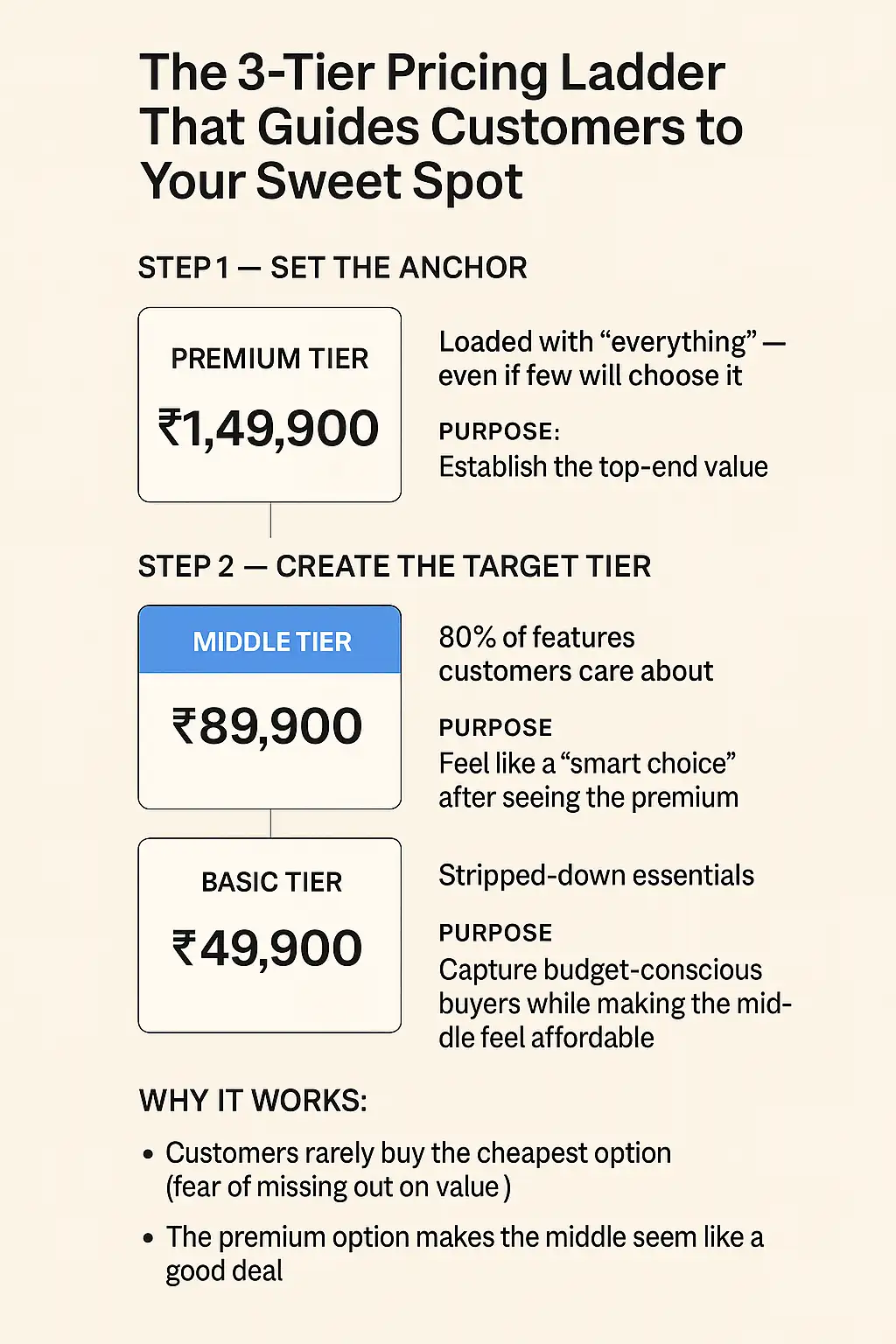
When people see a price, they don’t evaluate it in isolation.
They compare it — often subconsciously — to the first number they noticed in that context.
That “first number” is the anchor. And once it’s set, it quietly shapes every judgment that follows.
Why the brain can’t ignore an anchor
Anchoring is one of the most consistent cognitive biases studied in behavioral economics.
In the 1970s, psychologists Daniel Kahneman and Amos Tversky showed that even irrelevant numbers influence decisions. When participants spun a wheel rigged to land on either 10 or 65, then guessed the percentage of African nations in the UN, those who saw “65” gave much higher estimates than those who saw “10.”
The number had nothing to do with the question — but it still pulled the answer toward it.
In pricing, the same bias means the first number a customer encounters — whether it’s a premium option, an “original” price, or a competitor’s rate — sets the mental benchmark for what follows.
How brands apply anchoring in the wild
-
Luxury as a frame — A fine-dining restaurant lists a bottle of wine for ₹15,000 at the top of the menu, not to sell it, but to make the ₹5,500 bottle feel more reasonable.
-
Reference pricing — An e-commerce site shows “was ₹9,999, now ₹6,499” to make the deal feel larger.
-
Decoy effect — A cinema prices a small popcorn at ₹180, a large at ₹300, and a medium at ₹280 — making the large seem like the obvious choice.
A 2019 MIT Sloan study found that simply introducing a premium “anchor” product into a menu or catalog increased average transaction values by up to 13%, even if few customers purchased the top-tier item.
Making anchoring work without eroding trust
Anchoring isn’t about trickery — it’s about framing value. To use it effectively:
1. Lead with the high-value option — Your top package or premium model should be the first number people see.
2. Contextualize the cost — ₹35,000 for a training program might feel steep — until you break it down to “less than ₹96 a day” over a year.
3. Keep it believable — If the anchor feels inflated or fake, customers notice, and trust drops.
Why this matters for business leaders
Your pricing presentation can shift perceived value before you’ve even explained the product. Done right, anchoring helps you:
-
Increase average order value without discounts.
-
Make premium options more accessible.
-
Frame investments in a way that feels justified, not indulgent.
In most markets, you don’t control the customer’s budget. But you do control the first number they see — and that means you control the lens through which every other price is judged.