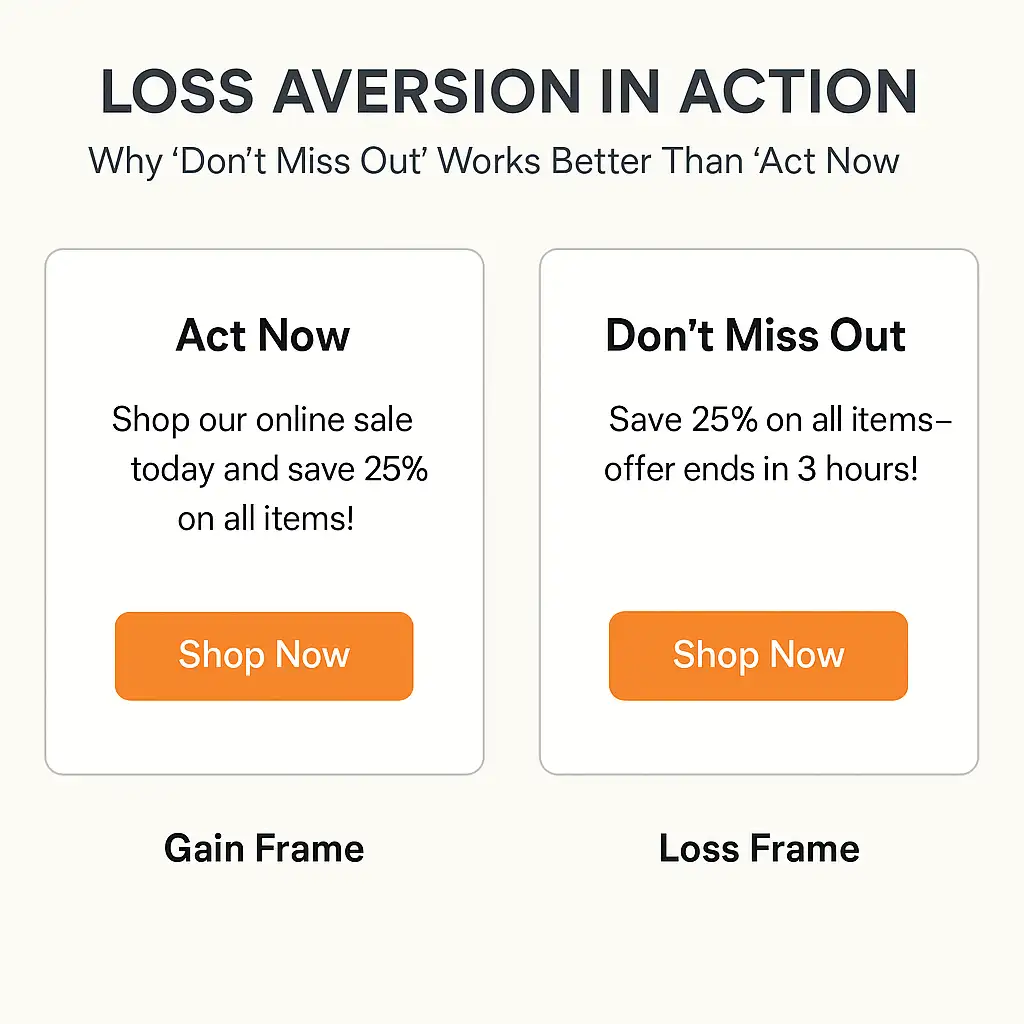
Scroll through any high-performing campaign, and you’ll notice something:
The copy isn’t just telling you what you could gain. It’s telling you what you stand to lose.
That’s because our brains are wired to hate loss more than we love gain.
Behavioral economists Daniel Kahneman and Amos Tversky quantified it in their Prospect Theory research: losing ₹1,000 hurts about twice as much as winning ₹1,000 feels good.
Why “Don’t Miss Out” hits harder than “Act Now”
The principle is simple:
-
“Act Now” is an invitation.
-
“Don’t Miss Out” is a warning.
One appeals to opportunity, the other to avoidance of regret. And avoidance is a stronger motivator.
In experiments, framing the same offer in loss terms (“You’ll lose ₹500 if you don’t…”) consistently drove higher conversion than gain terms (“You’ll earn ₹500 if you do…”).
Where this shows up in marketing
-
Ticket sales — “Only 12 seats left” works better than “Book your seat now.”
-
E-commerce — “Offer ends in 3 hours” outperforms “Offer available today.”
-
B2B services — “Competitors are already implementing X” can spark action faster than “Implement X to grow.”
A 2020 CXL Institute test found that loss-framed CTAs increased clicks by up to 32% in certain e-commerce segments.
The fine line between urgency and fatigue
Overuse is where many brands stumble. When every email screams “Last chance!” people tune it out — or worse, stop trusting you.
The danger signs:
-
Deadlines that keep extending.
-
“Low stock” messages on items that never run out.
-
Constant “don’t miss” pushes that create false urgency.
Once trust erodes, urgency tactics lose their punch — and so does your brand.
Using loss aversion the right way
1. Make scarcity real — If you say it’s limited, it must be.
2. Tie loss to specific value — Don’t just say “Don’t miss out” — spell out exactly what they’ll lose.
3. Rotate the trigger — Use it sparingly, so it still stands out when it appears.
Bottom line: People will work harder to avoid losing something than to gain something new. Use that truth carefully, and your campaigns will feel motivating, not manipulative.
We help brands bake loss aversion into their messaging in ways that lift conversions and protect trust — because in the long game, the only thing you don’t want to lose is credibility.